

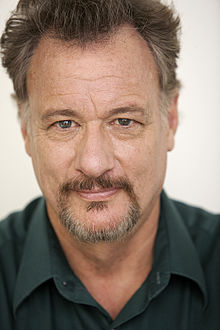
As the devious Q, John de Lancie has reached audiences en masse through the “Star Trek” franchise, an exclamation point in a long acting career. But to fans of “My Little Pony: Friendship is Magic,” he’s simply known as Discord.
In 2012, de Lancie, along with producers Mike Brockhoff, Lauren Faust and Tara Strong, as well as director Laurent Malaquais, set out to make a documentary on Bronycon, which later morphed into the final product, “Bronies: The Extremely Unexpected Adult Fans of My Little Pony.”
The Daily Oat spoke to de Lancie about his experience making the “Bronies” documentary, not long after the film’s release to contributors.
Editor’s Note: This interview was conducted prior to the news that the producers of “Bronies” had ceased production on additional material, de Lancie himself citing rampant piracy of the film, noting that he was “disappointed and disillusioned.” The delay in posting this interview (which chiefly owes itself to unfortunate computer issues) is the reason for which recent developments are not touched upon by the interviewer or by de Lancie. The Daily Oat apologizes for this delay and any misunderstandings that might arise as a result.
Four String: Obviously, the main focus here is the “Bronies” documentary, and now that it’s been out for a couple of days, many people have seen it, including, I’m assuming, yourself. Are you pleased with the final product?
John de Lancie: Yeah, I am. I am.
FS: And was the final product what you expected it to be early on?
JdL: Well, making a documentary is all about morphing. You talk about what you hope to get and go out there and make something that sort of feels that way, but has a lot of other things going on. Then you stream in our case about 300-400 hours of film into the editing room and then you kind of go, “Jeez, what do we really have here? Is it telling a coherent story?” So, it is a constant process of refocusing and adjustment. There were times that we despaired and there were other times that we went, “Oh, we’ve really got it!” but then a few days later we discover that, “Oh, that section doesn’t really work.” So, it was always growing.
FS: When you first got involved with this project, did you ever imagine it would grow to the scope it ended up going to? Going from a documentary on Bronycon to this giant thing about bronies as a whole?
JdL: No, we didn’t. When we first decided to do it, we went to Kickstarter and suggested that it should be a $60,000 event, which meant, at best, two cameras and probably six weeks worth of editing. It would be, in comparison to what you see on [the documentary], a very modest effort.
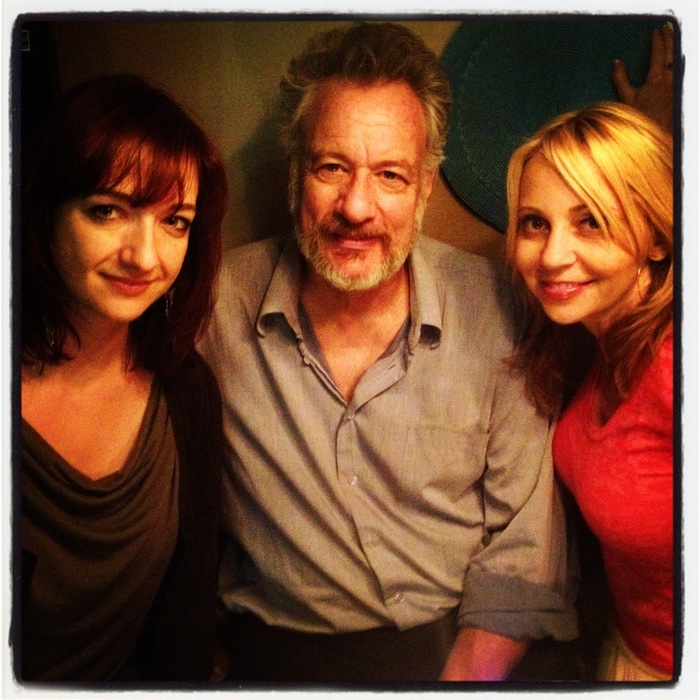
de Lancie (center), with fellow “Bronies” producers Faust (left) and Strong.
When we got as much money as we did, Mike [Brockhoff, executive producer] and I made the decision — perhaps not the best decision but in any case, we made it — that all of the money, every bit of it, had to go back into the documentary, and that the way to spend it was to simply expand the stories. So, what was to be Mike coming to New York and shooting with the camera, and then going home actually ended up [involving] going to concentric circles out. Going to Maine, going to North Carolina, going to San Diego, continuing to shoot in Los Angeles, and then going as far out as Israel, Germany, England.
Let’s say with a $60,000 budget, we would have shot 50 hours. In the end, we shot about 300. Well, that means you can’t just have one editor; you need to have three editors. Everything expanded.
FS: The documentary has definitely been met with its share of feedback. Many bronies have praised it, some I’ve seen actually calling it their favorite movie, for better or for worse. On the other side, the film has had its critics, some calling the film too congratulatory and biased toward bronies, reinforcing some negative stereotypes the general public already has about the fandom. What’s your response to that criticism?
JdL: Well, I would suggest that they go and make their own documentary. We made the documentary that we saw and that we wanted to make. We did not make it based on what their notion was. We made it with trying to be a mirror up to what we saw. You know, there were people who asked me why I wasn’t getting involved in… I don’t know what it was, the furries or the cloppers, and I said, “Well, first of all, we didn’t see that.” If I were to make a documentary on… say,”The Andy Griffith Show,” and if that was going to be the first documentary about “The Andy Griffith Show” to go off and talk about how people dress up as Andy Griffith and Aunt B… I mean, it’s just off the subject.
What was already fascinating is that a bunch of guys were willing to break the ridicule of being called, you know, “You’re all gay,” and the much worse way of saying that; you’re all pedophiles, and you’re all really weird and stuff like that, to watch a show that’s actually about being good. It’s so out of proportion, the way people are willing to demonize these guys who are simply watching a cartoon that happens to be about nice things and nice people doing nice… you know, be kind, be generous and loyal and whatever. And we’re going to go and demonize those people? As a media we feel that they’re fair game?
So that was the reason that we did the documentary, to give some opportunity for a general public who has never been to a brony convention, and or any other convention for that matter. To go into this world the same way as Lyle’s dad who as he said, “well, what do you expect to see there? A lot of guys with pink hair, and dresses on.” And they end up, although a little bit begrudgingly, go “Well, yeah, you know, it’s not that bad.” That was the intent.
FS: So in other words it was very important to approach the film the way you did to give the bronies the spotlight and to explain themselves rather than looking at them through a magnifying glass or having some other media do it for them?
JdL: Yes, very much so. The intent of the film was, from a brony’s point of view, simply to show a mirror.
Here’s the mirror. Now is it the mirror for every brony? Is it a light shining into every little crevice? Of course not; it’s 87 minutes. But more importantly, the intent of the film, is that it gets to be shown to people who, at best, have no point of view, or, at worse, have a very, very negative [point of view], for which you could end up saying to them, “There now, what are you so fearful about?” What is there that’s so horrible that you are willing to make really unpleasant comments about something you don’t know anything about?
I’m not going to necessarily watch the show [regularly], but I wanted to make sure that I understood what it felt like to watch the show. And so I went through that proc
ess. That’s what this film is. Hopefully, we will be able to have this film seen by a non-brony, large population, who will then ask themselves the question, “What is it about our society that would demonize guys because they want to watch ‘My Little Pony’?” What is it about our society
that actually has nothing for guys who are 20 years old, who actually are interested perhaps in conflict resolution, getting along and making sure things work out. On and on and on, so that a larger question, a larger dialogue, will take place.
FS: You’ve been involved with both the “Star Trek” and “My Little Pony” fandoms, both cultures considered by many to be deviants from the norm. How do the two compare from your perspective?
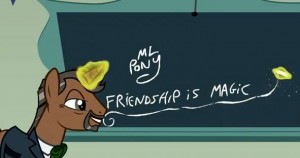
A ponified de Lancie teaches the ins and outs of bronies in an animated segment of the film.
JdL: There are similarities. The Trekkies were people who were not going to be going out for the baseball team,and the girls weren’t going to be the prom queens. So they were not people who lived in that middle world, where society looks well upon them. These “Star Trek” people were the early geeks, the nerds, the people were more intellectual, were a little more interested in science and industry and reading… you know, all this type of stuff. Which is, let’s say, the opposite of sports; I’m making huge generalization here.
They have a creative community. So when I first discovered bronies, I saw the similarities. When I got into “Star Trek,” classic “Trek” had happened, and I came in with the next generation. So I wasn’t really there at the beginning, but I did feel that I was there pretty close to the beginning of the bronies, if you consider if it were to go on for another 10 or 15 or 20 years or what have you, I was really there at the beginning
That’s why I have a particular sort of empathy for these guys who were trying to do something that I thought to be just fine. It wouldn’t have been the way I would’ve done it, but then again, I am, you know, 40 years older than most of the people here. But I recognize that, even though, the way I would have gotten involved, that they did get involved and they were creating a community and it was fitted around stuff which was good, as opposed to, you know, Swastikas tattooed to your forehead or something like that.
I just thought, “Why are they being depicted in the same sort of violent and disgusting sort of way as if they did have Swastikas attached to their foreheads?” I mean, good god! We got to the point in our society that watching a show that is about being kind and generous and loyal is only okay if it’s exactly gender specific?
And that’s when I said, “Look, these guys need a little space, and this documentary could give them that, could give them the opportunity to identify themselves to the world before they are identified.
FS: What’s the current situation with the documentary, now that it’s out?
JdL: It’s just everywhere. You can download it anywhere, and our super objective, certainly mine and Mike’s, was to get this out to not the bronies — we felt a contractual obligation of course to get it out to the contributors — but then to get it to the general public, because that’s where people are going to take bronies seriously.
Right now, we’re faced with this unanticipated dilemma. When we go to a distributor, the distributor, he simply goes, “My god, you can find this everywhere!” They just go look at the numbers, and those numbers are gonna say to them, “Oh, I don’t think so, everybody who’s gonna get it has got it one way another, and we’ve got to put advertising into this, we’ve got to put marketing into this and it just feels like it’s available already.”
And at that point it’s just gonna die, because obviously we’re not gonna make a lifetime of devotion to making sure the documentar

de Lancie at Bronycon, Credit: www.timesunion.com
y, which is really intended for the general public, to educate the general public as to who bronies are, but also to be an opportunity for that general public audience to think to themselves, “Huh, maybe I am too quick to judge, maybe I should open up, maybe I should be more tolerant.” We won’t get that sort of exposure.
FS: What’s the future hold for you right now?
JdL: I’m sailing to Tahiti.
FS: Ooh, fun! So is it like a vacation?
JdL: Well, it’s going to be more than a vacation; it’s going to be about 7,000 miles of open ocean. I’m doing it with three other guys and we’re going to be gone for four months.
FS: In the “Bronies” film, you divide the brony fandom into three main groups: hipsters, moderates and creatives. Into which category do you think you fall?
JdL: Creative; my whole life’s been that way. That’s what I was particularly interested in about the bronies; I’ve never quite understood the sporting public because more often than not they’re just sitting watching somebody else do something. What I was so attracted to about the bronies is they get out and do it themselves.

Reading this somehow puts a more positive spin on the documentary for me, but I can’t exactly explain why. That and now I feel even worse for John de Lancie after all that pirating.
Nice article. You really got JdL to explain. The pirating really made me mad, but I don’t need to hear his take on it. I think he made that clear on Twitter. I agree most Bronies are good people, as most people are good. There’s just always a group that has to spoil the fun and success for everyone.